
India’s economy will grow an average of 6.3 percent in the 2025-26 fiscal year, and the growth rate will be slightly up in 2026-27 with 6.4 percent growth.
This is the forecast of the OECD. The Paris-based Organization for Economic Cooperation and Development says India's economy will expand by 6.3 percent in 2025-26 and 6.4 percent in 2026-27. It is very clear that India will continue to be the fastest-growing G20 economy amidst global uncertainties.
World Bank report also reiterates high growth.A similar view has also come from the World Bank in its Global Economic Prospects report, which expects the Indian economy to be growing by 6.3 percent in 2025-26.
In April this year, the World Bank cut the projected growth rate by 40 basis points (bps). However, it cautioned that the pace of investments may slow down due to global uncertainty.
However, at the projected 6.3 percent growth, India will remain the fastest-growing large economy.
“India is projected to maintain the fastest growth rate among the world’s largest economies, at 6.3 percent in FY2025/26. Nevertheless, the forecast for growth in FY2025/26 has been downgraded by 0.4 percentage points relative to January projections, with exports dampened by weaker activity in key trading partners and rising global trade barriers. Investment growth is expected to slow, primarily reflecting a surge in global policy uncertainty,” the World Bank observed.
India becoming fourth largest global economyMeanwhile, India’s GDP ($4,187 billion) will surpass Japan’s economy ($4,186 billion) to become the fourth largest global economy by the end of this year (FY26), according to the IMF's latest World Economic Outlook report.
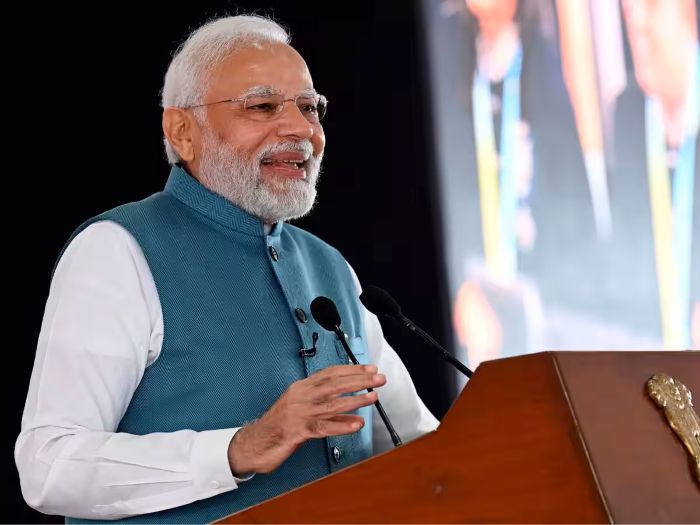
Reflecting on the country’s economic momentum in the past decade, Prime Minister Narendra Modi said on the occasion of NDA completing 11 years in office on June 9, the PM said a clear focus on good governance and transformation with citizen participation had been the engine behind tremendous growth across diverse sectors.
OECD sees slump in global growth.The Paris-based Organization for Economic Cooperation and Development (OECD) also warned that global growth may slump to 2.9 percent in 2025 and 2026 due to barriers to trade, tighter financial conditions, diminishing confidence, and heightened policy uncertainty.
In its findings on India, the OECD said private consumption and investment will remain strong in India, but the export growth may cool off due to weaker global demand and turbulences at the trade policy fronts.
This is also OECD’s trimmed forecast. It noted private consumption in India is staying strong due to rising real incomes and lower personal income taxes.
The OECD holds the view that the investment outlook is bright, spurred by easing financial conditions. At the flipside, high merchandise export exposure to the US export market can add some vulnerability to private investment in the wake of shifts in trade policy.
Tariff hikes and trade tensions can dampen investor sentiment in export-intensive sectors like chemicals, textiles, and electronics.
However, any adverse impact on GDP is minimal, as merchandise exports towards the US are only 2.1 percent of GDP. Noting that the global economy has shifted from a period of resilient growth and declining inflation to an uncertain path. OECD Secretary-General Mathias Cormann urged governments to engage mutually to address issues in the global trading system and hold constructive dialogue.

Mathias Cormann, OECD Secretary-General
New monetary policy to catalyse growthMeanwhile, the RBI released its latest Monetary Policy update on the 6th of June, 2025, after its Monetary Policy Committee announced some major decisions. They included a repo rate reduction by 50 basis points (bps) to 5.50 percent with immediate effect.
The repo rate is the interest rate at which the RBI lends money to commercial banks. This is the interest rate at which the Reserve Bank provides liquidity under the liquidity adjustment facility (LAF) to the concerned participants against the collateral of government and other approved securities.
Consequent adjustments will also come over in the Standing Deposit Facility (SDF) rate under the Liquidity Adjustment Facility (LAF) at 5.25 percent and the Marginal Standing Facility (MSF) rate, and the Bank Rate will be 5.75 percent.
The RBI hopes to fulfil the objective of achieving the medium-term target for consumer price index (CPI) inflation of 4 percent within a band of +/- 2 percent while stepping up growth momentum.
Commodity prices mellowingThe policy also takes a view of different factors that may impact the economy in the months ahead. The report notes even though uncertainty around the global economic outlook has slightly diminished, multilateral agencies can still revise global growth projections downwards.
Market volatility has eased in the recent period with equity markets staging a recovery and the softening of the dollar index and crude oil price even as gold prices remain high.
The RBI conclave noted that economic activity continues to maintain the momentum in 2025-26, supported by private consumption and traction in fixed capital formation. Investment activity may improve further in light of higher capacity utilization, improving balance sheets of financial and non-financial corporates, and the government’s capital expenditure push.
Challenges at the trade frontTrade policy uncertainty continues to weigh on export growth. However, the trade agreement (FTA) sealed between the United Kingdom and progress with other countries will boost trade activity. Agriculture prospects are looking bright on the back of an above-normal southwest monsoon forecast and resilient allied activities. The services sector will keep its momentum.
Among the challenges to growth are spillovers from protracted geopolitical tensions, global trade, and climate-related uncertainties.
Factoring in all important variables, the policy projects real GDP growth for 2025-26 at 6.5 percent. In terms of quarterly growth, the break up will be Q1 at 6.5 percent, Q2 at 6.7 percent, Q3 at 6.6 percent, and Q4 at 6.3 percent.
On inflation, CPI headline inflation continued its dip in March and April by slowing to a nearly six-year low of 3.2 percent (year-on-year) in April 2025.
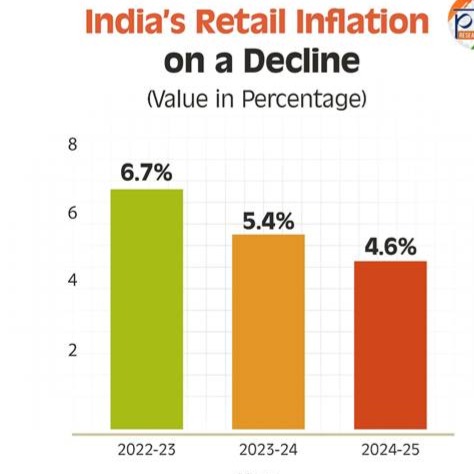
Consumer food price inflation (CFPI) at 1.8 percent in April 2025, was the lowest since October 2021. The headline inflation at 3.2 was also the lowest since July 2019. However, core inflation at 4.2 percent has been the highest since September 2023.
Food inflation fell, showing the sixth consecutive monthly decline. Core inflation excluding food and fuel also declined from over 6 percent in early 2023 to nearly 4 percent in April this year.
RBI Governor takes realistic standExpressing a realistic approach RBI Governor Sanjay Malhotra noted that in the wake of global uncertainties, the economic growth rate and trade projections have been suitably revised downward.
There is a challenge to financial stability amidst global spillover alongside he impact of tech challenges posed by AI and other innovations.
The confident outlook on inflation stems from the benign prices across major segments. They include record wheat production and higher production of key pulses in the Rabi crop season, and the forecast of an above-normal monsoon with its early onset augurs well for Kharif crops, affirming an adequate supply of key food items. Cumulatively, they indicate inflation is on a moderating trend, more so for the rural households.
The outlook also draws cues from projections that point towards moderation in the prices of key commodities, including crude oil.
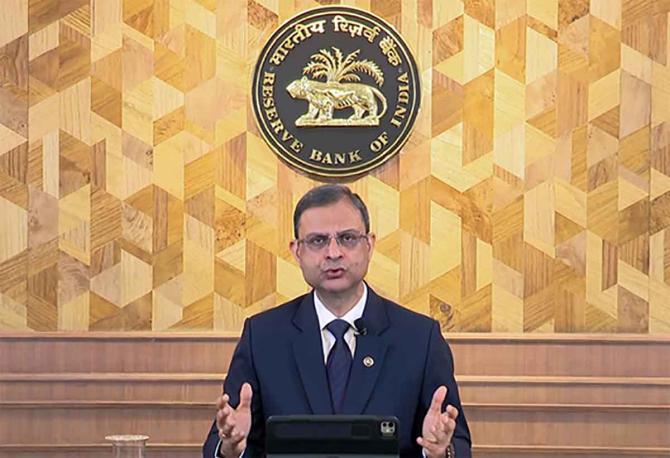
Mr. Sanjay Malhotra, Governor, RBI
Rate Cut will boost consumption growthReacting to the MPC decision to cut repo rates, Ranen Banerjee, Partner and Leader, Economic Advisory, PwC India, described it as an unexpected outsized policy rate cut of 50 bps against a consensus expectation of a 25 bps cut. Supplementing the bold move are a 100 bps staggered cut in CRR and a change in policy stance to neutral.
Banerjee believes the decision could be the outcome of the weakness in GDP prints for Q4 of FY25, mainly in manufacturing and consumption. The adverse impacts of global trade and conflict headwinds could also have forced the hand of the RBI.
The rate easing, alongside the liquidity increase for banks at a time system liquidity is comfortable, is a second engine to the consumption growth that gets ready, aided further by income tax cuts that are taking effect in FY26.
The rate reduction will be significantly positive for urban consumption, which printed weak in past quarters. This will make a positive impact and create momentum in the real estate sector and also in discretionary purchases and private capex.